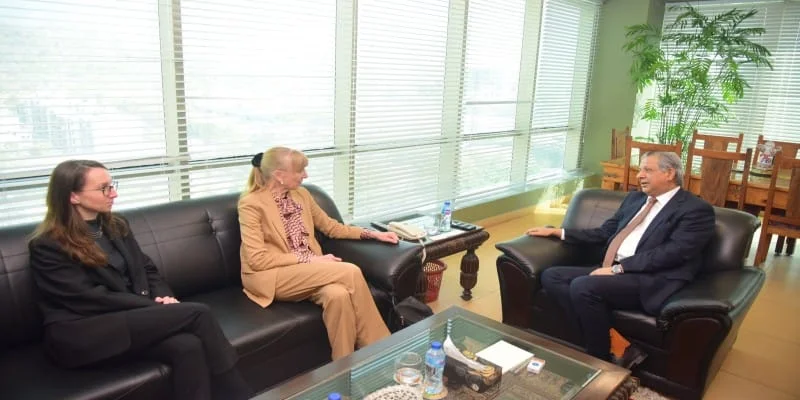

German Ambassador Ina Lepel paid a courtesy call on Federal Minister for Law and Justice and Human Rights, Azam Nazeer Tarar, to discuss bilateral cooperation in human rights and review key legal initiatives underway in Pakistan.
The meeting focused on strengthening collaboration between Pakistan and Germany in promoting and protecting minority rights, as well as advancing ongoing legal reforms.
Minister Tarar briefed the Ambassador on recent constitutional and legislative developments designed to enhance governance and reinforce the protection of fundamental rights.
He noted that the country’s overall human rights situation has improved in recent years, citing a decline in rights-related violations and more effective institutional responses to grievances.
The Minister highlighted the proactive role of the Ministry of Human Rights in coordination with relevant departments and stakeholders to strengthen legal safeguards and ensure accountability.
He emphasized the government’s continued commitment to reform-oriented policies aimed at ensuring equitable justice and protecting vulnerable communities.
Reaffirming Pakistan’s commitment to the European Union’s GSP+ framework, Minister Tarar underscored its importance in promoting governance reforms, institutional strengthening, and sustainable development.
He also referred to Pakistan’s recent election to the United Nations Human Rights Council, describing it as a reflection of the international community’s confidence in Pakistan’s constructive engagement on human rights issues.
Ambassador Lepel commended Pakistan’s recent legal reforms, particularly amendments to the Pakistan Penal Code that have reduced the scope of the death penalty by substituting life imprisonment for certain offences.
She also acknowledged the establishment and effective functioning of the National Commission for the Protection of Journalists and Media Professionals, noting its positive contribution to safeguarding media workers.
Minister Tarar further highlighted the creation of the National Commission for Minorities Rights through an Act of Parliament, granting it quasi-judicial powers to address grievances and promote minority protections.
He added that key statutory bodies, including the National Commission for Human Rights, National Commission on the Status of Women, and National Commission on the Rights of Child, continue to function effectively in advancing their respective mandates.
The discussion also covered the Legal Aid and Justice Authority and its initiatives to improve justice sector responses, particularly through capacity-building for service providers and coordinated strategies to combat gender-based violence.