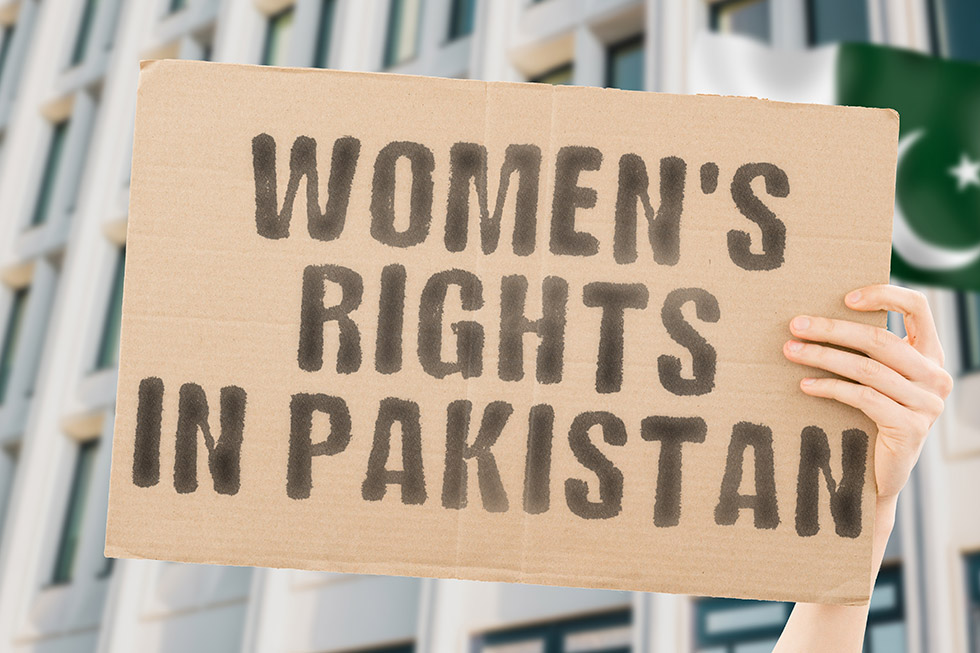
Pakistani women have made meaningful progress across public and professional spheres, challenging the long-standing assumptions about their roles and capabilities. Yet cultural norms, political structures and religious misinterpretations continue to hinder their ability to participate fully and equally in society. Continued efforts toward gender equality are essential for enabling women to reach their full potential.
Gender equality is central to a society that strives to bring justice and fairness. Yet in many parts of the world, access to opportunities has been far from equitable. In Pakistan, women continue to struggle to find opportunities that men already have. Although some have risen to prominence and secured opportunities in several male-dominated fields, such as the judiciary, armed forces, politics, science and technology, they continue to face hurdles in their quest to realize their full potential.
When women refuse to stay behind
Although women in Pakistan are far behind their male counterparts in every sphere of life, a handful of them have made notable strides in many sectors. In Pakistan’s judiciary, female judges comprise 519 out of 3,005 total judges, representing a remarkable improvement from a decade ago, when the number of female judges stood at a mere 5%. This growth cannot be attributed only to women recognizing the importance of their presence in the Judiciary; It also reflects broader societal and institutional changes, including gradual policy reforms and increased acceptance within male-dominated legal and judicial structures.
Similarly, Pakistani women are increasingly involved in their contribution to the government, both as local civil servants and as national representatives for various nations and organizations. An increasing number of Pakistani women are now taking part in the civil service examinations, aspiring to work as government civil servants. In 2024 alone, 110 women out of a total of 219 candidates successfully joined the government bureaucracy. Although Pakistani women have persistently faced challenges in the political sphere, the likes of Asma Jahangir, Benazir Bhutto, Shireen Mazari, Shery Rehman and Dr Sania Nishter have been pivotal in changing and influencing policies that ensure and promote gender equity.
Moreover, the number of women inductees into the armed forces has substantially increased since Pakistan’s separation from India. Women have been encouraged, especially through institutional policies, social messaging and expanding career opportunities, to join the military, a domain that has traditionally been seen as male-dominated. Inspired by the likes of Rana Liaqat Ali Khan, founder of the Women’s National Guard in 1949, to Nigar Johar, the third female major general and first lieutenant general, there has been a growing number of patriotic Pakistani women interested in leading a career in the military.
Pakistani women have also fought Pakistan’s conservative societal system to make a mark in international sports, including cricket, mountaineering, football, hockey and badminton. The sports accomplishments of Kiran Khan, Sana Mir, Bisma Maroof, Naila Kiani and Samina Baig have been instrumental in laying the groundwork for more women to pursue sports freely and actively. Nearly 3,000 women have been enrolled in sports training under the Prime Minister’s Youth Program as of Fiscal Year 2025 (FY2025), of which 250 registered were for boxing and 2,731 for cricket.
The forces that continue to hold Pakistani women down
Cultural institutions are the primary barrier for Pakistani women’s pursuit of equality. The tradition and cultural dogmas are highly skewed in favor of men and are unfavorable to women. Since their childhood, young girls are taught to internalize and are brainwashed to believe that their sole purpose is to be a mother and a housewife, whereas it is taught that men are the providers of the family. Moreover, the institutional glass ceiling is still at play. In Pakistan, women are often given reserved seats or quotas in politics and education rather than being allowed to compete on equal footing with their male counterparts.
Another impediment stems from Pakistan’s prevalent political culture. For the most part, the entire political atmosphere in the country is male-dominated. Currently, there are over 170 registered political parties, none of which is led by a woman. Unfortunately, some successful women themselves exhibit what is known as the “queen bee syndrome”, hindering other women from advancing to the same positions. Hence, a vicious cycle of nepotism ensues. Therefore, such impediments are required to be uprooted once and for all to pave the way for female equity in Pakistan.
Pakistan’s constitution, guided by the Qur’an and Sunnah, grants women equality, yet these rights are often undermined. Pakistan’s women continue to wrongfully face prejudice and discrimination in the pursuit of their due rights and opportunities in the name of religion because of the religious clergy. The clergy, also known as the maulvis, are all men. They are often known to be biased against women for their severe, harsh and at times misleading interpretations of Islamic injunctions. The will of the clergy is embedded in every rule and policy that aims at guiding the lives of women. Although the preamble of the Constitution, also known as the Objective Resolution, ensures social justice and equality, women continue to face setbacks due to the interference of external advisors such as Maulvis under the guise of religion.
What must change to let parity occur?
Women are still short of realizing their true potential due to impediments in their way. Cultural parochialism, political hindrances and nepotism, and the misinterpretation of Islamic injunctions are bottlenecks that need to be uprooted. The authorities need to implement national laws and international obligations in letter and spirit. The safety of women should be ensured. Meritocracy should be made a norm so that women never feel left behind. Only constructive and unbiased input should be taken from the clergy for policy making to make sure women are not disadvantaged.
Honoring women’s rights, implementing national and international obligations about gender equality and nurturing the culture of merit are the remedies that can ensure the equitable attainment of opportunities by all genders. These obstructions can be addressed to pave the way for women to leapfrog in life smoothly. Such a state of affairs dispels the impression that Pakistani women cannot be as successful as men, given that women are as free and resource-equipped as men.