
Thought the vast majority of companies in the Middle East have reinvention strategies in place, less than 1 in 10 are progressing at scale, according to a new report from Accenture.
Businesses in the Middle East are responding to the seismic impact of generative AI. But despite this momentum, emerging gaps could begin to divide the future winners and laggards in the digital race.
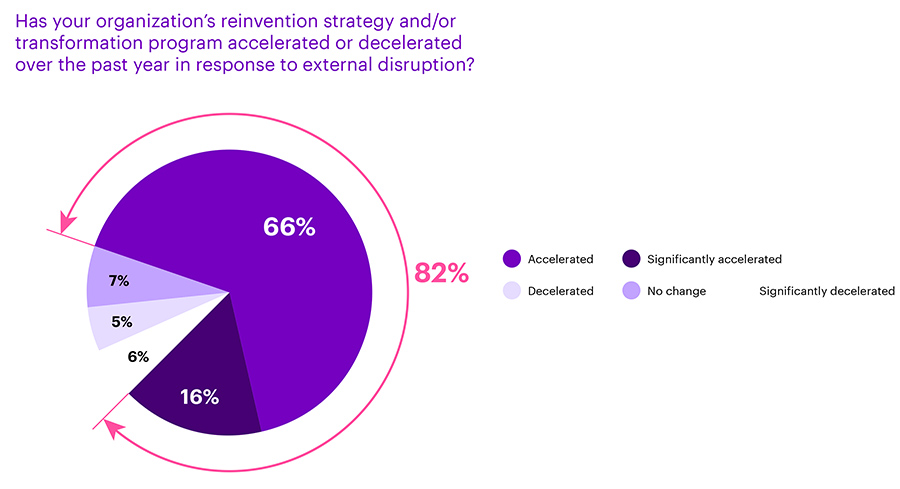
The Accenture report found that 86% of Middle Eastern companies already have a reinvention strategy in place and 82% have accelerated their reinvention efforts in the past year. However, execution is uneven as only 9% of companies are progressing at scale. That such a small percentage of respondents were seen to be making progress highlights the fact that many companies are not doing enough to keep up.
Ramez Shehadi, Strategy & Consulting Lead for the Middle East and Africa, said: “The Middle East isn’t short on ambition or AI infrastructure – but too few organizations are turning that into enterprise-wide reinvention. The real divide now isn’t between nations, it’s between institutions that scale fast and those that simply think about it.”
Source: Accenture
AI-driven reinvention
The urgency around transformation has created a significant separation between the few leading companies and the struggling majority.
Accenture’s research categorizes Middle Eastern based on their progress in enterprise reinvention.
Companies performing the worst – a total of 14% of those surveyed – meet none of the criteria for enterprise transformation. This percentage is four points higher than the global average, signaling a risk that the Middle East could lag behind other major economic markets if these organizations do not move swiftly.
Only 9% of organizations in the region were considered to be making swift, scaled progress in executing a strategy with technology at its core.
Source: Accenture
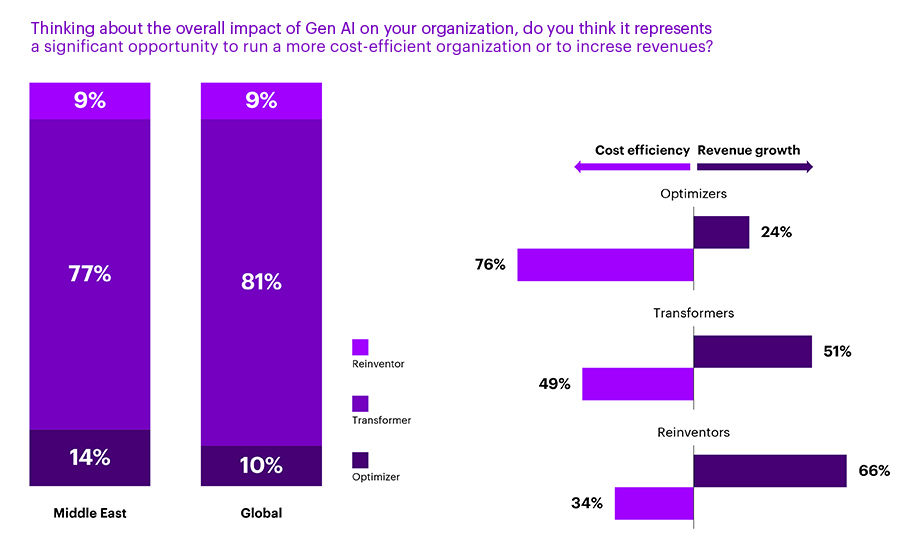
Organizations that have successfully embraced continuous, organizational-wide reinvention have seen a 15 percentage-point premium on revenue growth since 2019, alongside a 6 percentage-point premium on profits. This success stems from a fundamental difference in philosophy: those that perform the best see GenAI primarily as an engine for revenue growth.
The winners are clearly reimagining their businesses to increase the top line, not just trimming the fat from the bottom.
AI and Generative AI were found to be strong drivers of reinvention. 76% of business leaders in the region believe that Gen AI could boost output per worker by more than 10% in the next three years. In Saudi Arabia, 38% of working hours are in scope for automation or augmentation, offering companies a key opportunity for reinvention.
Source: Accenture
Closing the gap from strategy to execution
To close this reinvention gap, companies must move beyond siloed experiments and isolated use cases that, while promising, have yet to make a material impact on the bottom line. The core shift must be towards a value-led approach, identifying opportunities across the entire value chain where GenAI can create unique, defensible competitive advantages.
A successful strategy rests on five key imperatives, starting with the foundation: the digital core. Four out of five Middle East executives (81%) recognize this necessity and expect to fundamentally reinvent their IT function over the next three years. This involves replacing fragmented, disconnected systems with an integrated core that brings together cloud, data, AI, and security, thereby creating a new, data-driven GenAI backbone.
However, technology is only part of the equation; people are the essential component. Companies must reinvent talent and ways of working, recognizing that GenAI is not about replacement, but augmentation. The technology is an opportunity to alleviate the burden of repetitive, menial tasks, freeing up employees to focus on higher value-add activities such as creativity and strategic thinking.
Source: Accenture
Furthermore, the scale of this technological shift demands leadership in Responsible AI. Trust is the currency of scaled adoption, and organizations must develop a comprehensive ethical framework – one grounded in local cultural values, that promotes public trust, and ensures transparency and accountability.
Reinvention must then be viewed as an embedded, continuous capability, part of the organizational DNA. In a region defined by rapid change – where the rate of disruption across key factors has grown 97% since 2019 – this continuous evolution allows leaders to track ROI dynamically and proactively adapt strategies.
This moment is a defining opportunity, according to the report. For a region renowned for its bold vision and ambition, the rise of GenAI offers the tools to transform companies from followers into trailblazers and set new global performance benchmarks. Those who embrace what Accenture calls ‘Total Enterprise Reinvention’ – moving past experimentation to integrated, scaled execution – will not merely adapt to disruption but thrive on it.
Accenture’s report is based on a survey of 300 senior business executives from Saudi Arabia and the UAE across 19 industries in companies with $500 million or more in annual revenues.