
Killed in a joint US-Israeli strike on his Tehran compound on February 28, Khamenei’s death after 36 years in power leaves Iran with no designated successor and a vow of devastating retaliation from the IRGC.
Iran’s Supreme Leader Ayatollah Ali Khamenei was killed on Saturday in a joint US-Israeli attack on Tehran, Iranian state media confirmed, ending 36 years of absolute rule over the Islamic Republic and triggering an immediate succession crisis.
“It is announced to the Iranian people that His Eminence Grand Ayatollah Imam Sayyid Ali Khamenei, Leader of the Islamic Revolution, was martyred in the joint attack launched by America and the Zionist regime on the morning of Saturday, February 28,” Iran’s semi-official Tasnim News Agency reported. The government declared 40 days of national mourning.
The 86-year-old Khamenei was killed at his compound in downtown Tehran. Two Israeli officials, speaking to the Associated Press on condition of anonymity, confirmed his death after Prime Minister Benjamin Netanyahu said in a nationally televised address that there were “growing signs” Khamenei had been killed when Israel struck the compound. Reuters, citing an unnamed senior Israeli official, reported that Khamenei’s body had been located.
US President Donald Trump announced the death on social media, writing that Khamenei “was unable to avoid our Intelligence and Highly Sophisticated Tracking Systems and, working closely with Israel, there was not a thing he, or the other leaders that have been killed along with him, could do.” He warned that “heavy and pinpoint bombing” would continue “uninterrupted throughout the week or as long as necessary.”
Iranian state media also confirmed that Khamenei’s daughter, son-in-law, and grandson were killed in the strikes.
The operation—codenamed Roaring Lion by the Israeli military and Operation Epic Fury by the US Pentagon—began at dawn. The strikes targeted locations in Tehran, Isfahan, Qom, Karaj, and Kermanshah. An Israeli defence official quoted by Reuters said the attacks had been planned for months, with the launch date settled weeks earlier—even as the US and Iran were engaged in negotiations.
“The State of Israel has launched a preemptive strike against Iran to remove threats to the State of Israel,” Israeli Defence Minister Israel Katz said, declaring a state of emergency and warning of retaliatory drone and missile attacks. Netanyahu said the operation was launched “to remove the existential threat posed by the terrorist regime in Iran” and called on “all parts of the Iranian people—the Persians, the Kurds, the Azeris, the Baloch, and the Ahwazi—to cast off the yoke of tyranny and bring about a free and peace-seeking Iran.”
In a video posted on social media, Trump said the US had begun “major combat operations in Iran”, aimed at “eliminating imminent threats from the Iranian regime”. He acknowledged the possibility of American casualties, saying “that often happens in war”, and appealed to Iranians to “take over your government—it will be yours to take”.
The Israeli military said seven senior Iranian officials were killed alongside Khamenei, including IRGC [Islamic Revolutionary Guard Corps, the primary branch of the Iranian Armed Forces] commander General Mohammad Pakpour, Defence Minister Aziz Nasirzadeh, and Ali Shamkhani, secretary of Iran’s Supreme National Security Council. Israeli military spokesperson Brigadier General Effie Defrin confirmed the deaths in a televised statement, showing photographs of those killed.
The war and its victims
The strikes on February 28, 2026, targeted 24 provinces. At around 17:30 CET on the first day of strikes, the Red Crescent reported 201 dead and 747 injured across Iran. Among the worst incidents, a strike hit the Shajareh Tayyebeh girls’ elementary school in Minab, a city in Hormozgan province in southern Iran, killing 108 people according to Iran’s judiciary news agency Mizan. Two more students were killed in a separate school strike east of Tehran. Iranian Foreign Minister Abbas Araghchi said “dozens of innocent children have been murdered.” A US Central Command spokesperson said the military was “looking into” the school reports and that “the protection of civilians is of utmost importance.” There was no immediate Israeli response to the school strikes.
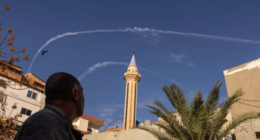
Sirens sounded throughout Israel as Iran launched retaliatory missile barrages. The IRGC warned that “the heaviest offensive operations in the history of the Armed Forces of the Islamic Republic of Iran will begin shortly toward the occupied lands and bases of the American terrorists.” Israeli airspace closed to civilian traffic, and the IDF [Israel Defense Forces, the national military of Israel] Home Front Command directed civilians to shelter in place. Several Israeli hospitals moved patients and surgeries to underground facilities.
Iranian President Masoud Pezeshkian was reported safe. “President Masoud Pezeshkian is safe and sound and has no problems,” state news agency Islamic Republic News Agency reported, with Mehr and Iranian Students’ News Agency carrying similar accounts.
The attack came a day after delegations from Iran and the US met in Geneva for a third round of nuclear negotiations. On February 27, Oman’s Foreign Minister Badr Albusaidi said a “breakthrough” had been reached, with Iran agreeing both never to stockpile enriched uranium and to full verification by the International Atomic Energy Agency. After the strikes began, Albusaidi said active negotiations mediated by his country had been “yet again undermined”. Trump said on February 27 he was not satisfied with how the talks were unfolding. He has demanded that Iran abandon its nuclear programme, curtail support for groups such as Hamas and Hezbollah, and scale back its long-range missile programme. Iran has maintained its right to enrich uranium and declined to discuss its missile programme or regional partners.
The Supreme Leader
Khamenei had served as Iran’s supreme leader since 1989, succeeding Ayatollah Ruhollah Khomeini, the founder of the post-revolutionary state, and previously served as president from 1981 to 1989. The supreme leader holds ultimate authority over all branches of government, the military, and the judiciary, while also serving as the country’s spiritual guide. His death leaves no designated successor. Under Iran’s constitution, an interim council assumes power while the Assembly of Experts—a body of 88 Islamic clerics—selects a new supreme leader. Israel says its opening strikes decimated the chain of command, killing seven senior defence and intelligence officials and targeting 30 top military and civilian leaders overall.
One senior official who survived is Ali Larijani—secretary of Iran’s Supreme National Security Council, former Parliament speaker, and one of Khamenei’s closest confidants. The New York Times reported earlier this month that Khamenei had put in place detailed plans for his succession and emergency chains of command should he or other top leaders be killed, elevating Larijani to manage the crisis. In a post on X on Saturday, Larijani vowed Iran would deliver Israel and the US an “unforgettable lesson”.
The US had assembled its largest military presence in West Asia in decades in the weeks before the strike. The current operation follows US-Israeli strikes on Iran’s nuclear installations in June 2025, which sparked a 12-day conflict. When those strikes occurred, Tehran confined its response, launching a retaliatory strike on an American air base in Qatar that reportedly caused minor damage and no casualties.
Iran’s ballistic missile programme operates under a self-imposed ceiling capping range at 2,000 kilometres—sufficient to cover all of West Asia and parts of eastern Europe. There is no public evidence of Iran pursuing intercontinental ballistic missiles, though Washington has raised concerns about its space programme as a potential long-term pathway.
The Government of India issued an advisory urging its citizens in Israel to “exercise utmost caution and remain vigilant at all times”, asking them to adhere to IDF Home Front Command guidelines, avoid non-essential travel, and monitor official announcements and emergency alerts.
EU foreign policy chief Kaja Kallas described the situation as “perilous” and called for civilians to be protected and international law upheld. Russia’s Ambassador to the UN, Vassily Nebenzia, demanded that the US and Israel “immediately cease their aggressive actions.” UN Secretary-General António Guterres condemned the strikes by both sides. “We are witnessing a grave threat to international peace and security,” he said at an emergency session of the UN Security Council.